Strategic Planning + Evaluation Framework
Missoula Metropolitan Planning Organization
This case study is co-authored by Beth Hegland, Rachel Huff-Doria, and Margo Stoney
Project Overview: A New Plan for Public Participation
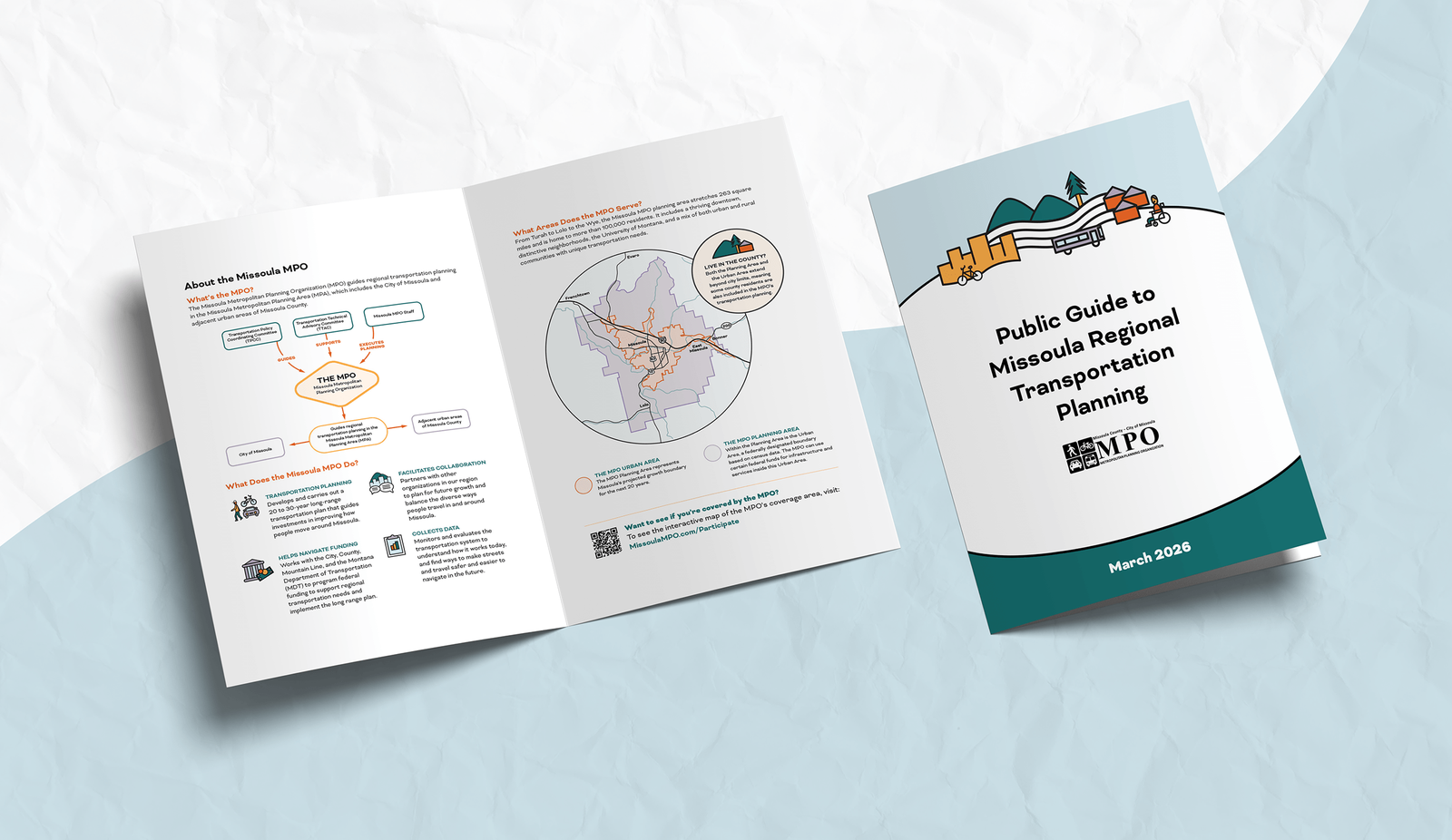
Together with Rachel Huff-Doria (RHD, LLC) and Margo Stoney (High Mountain Creative), Impactful Insights collaborated with Missoula Metropolitan Planning Organization (MPO) staff to develop and update the MPO’s Public Participation Plan (PPP), along with a supporting Infographic and evaluation framework. The goal was to move from project-by-project engagement toward a clear, consistent, and strategic approach that strengthens accountability, improves resource alignment, and builds sustained community relationships.
The updated PPP provides practical guidance for both public and staff audiences, clarifies roles and expectations, and establishes a repeatable framework adaptable across diverse planning initiatives. Included in the PPP are new and improved visual elements, including an Infographic that highlights key information for community members in a clear and easy to digest format. A complementary evaluation framework embeds feedback loops and measurable outcomes, ensuring engagement efforts generate actionable insight and support continuous improvement. Together, these deliverables position the MPO to approach public participation with greater intention, transparency, and long-term impact.
The Missoula Metropolitan Planning Organization: Using Public Participation to Plan Missoula’s Transportation Future
The Missoula Metropolitan Planning Organization is responsible for transportation planning for the region including the City of Missoula and adjacent urban areas of Missoula County.
The MPO carries out several key responsibilities:
Maintaining a continuing, coordinated, and comprehensive transportation planning program for the region
Helping local and state agencies secure and program federal transportation funding
Fostering cooperation between different levels of government
Providing information to government agencies and public and private organizations
Developing an integrated multimodal transportation plan that meets federal requirements and serves community needs
The MPO works across a wide range of stakeholder groups, including city and county staff, advisory committees, community organizations, and the general public, and supports both long-term planning efforts and shorter-term, targeted initiatives. Public participation is central to this work, and allows the MPO to inform and educate the community, gather meaningful input, involve residents throughout the planning process, and collaborate with partners to co-create transportation solutions that reflect diverse needs, priorities, and lived experiences.
These efforts are guided by a Public Participation Plan, which outlines how the MPO involves the public, and describes its processes, timelines, notification methods, and participation requirements.
Public Participation Plan Limitations Led to More Work + Fewer Insights
The MPO’s existing Public Participation Plan lacked clear goals and strategies for consistent engagement, which resulted in the MPO’s team having to start over when designing engagement processes and relationships for every project, rather than relying on a consistent, repeatable framework. This increased workloads for the MPO team and required a significant lift to stand up public engagement opportunities for each individual project.
Additionally, while the MPO’s existing PPP outlined the goals and benefits of public participation, it did not clearly link engagement strategies to intended outcomes, or provide clear guidance for measurement, evaluation, and learning.
The Goal: A Public Participation Plan that Supports Sustainable Engagement & Learning
In updating its Public Participation Plan, the MPO aimed to build on its past public engagement efforts and knowledge to establish a clearer, more strategic foundation for public engagement as well as evaluation. By clearly defining goals, strategies, and expected outcomes, the updated PPP needed to streamline project-by-project process design and provide a consistent, repeatable framework which could be adapted to meet the needs of diverse initiatives and stakeholders.
The revised plan also needed to provide staff with practical guidance, clarify how participation should be approached across planning cycles, and support more intentional use of limited capacity and resources. By explicitly linking engagement activities to desired outcomes, the new plan should strengthen accountability and lay the groundwork for more sustained community relationships.
To ensure the PPP enabled ongoing learning and improvement, the new PPP also needed a structured yet flexible evaluation strategy that could be applied across initiatives to provide a clear understanding of how effectively the MPO’s efforts support the goals of the PPP, enable input from diverse voices, and demonstrate follow-through on the MPO’s commitments.
Applying a Collaborative & Learning-Focused Approach
Input from stakeholders provided a clear starting point
Early in the process of developing the new PPP, the team invested time into gathering and analyzing information which would help to inform the direction of the work by identifying what clear, accessible and impactful public engagement might look like in Missoula.
This process included reviewing PPPs from other metropolitan areas to identify effective structures and best practices, surveying staff and advisory leaders to assess current engagement challenges and opportunities, and gathering input on how the updated document could be redesigned to improve clarity, usability, and accessibility.
Learnings provided clear direction and highlighted key needs
Through this initial analysis we identified that an effective PPP needed to:
Guide two different audiences: public and technical staff by tailoring information for both public and staff.
Enhance public understanding by creating clarity around the MPO’s role and jurisdiction, as well as when and how to engage - both identified as key barriers to public participation.
Build trust and transparency by building processes that incorporate clear feedback loops and communicate how input is used, even when decisions do not reflect the preferred outcome of all participants.
Improve inclusivity and accessibility by prioritizing efforts to reach traditionally underrepresented community members, as well as those outside of Missoula city limits.
Help the MPO to be more consistent and intentional by providing clear guidance on how to align engagement activities with goals, sustain public engagement across planning efforts, and use staff and external resources more strategically.
Clarify the role of committees and advisory groups by defining their purpose and how their input is used, improving how meetings are run and supported, and better reaching underrepresented groups across the MPO’s planning area.
The Result: A Stronger Framework for Engagement
These findings directly shaped the redevelopment of the Public Participation Plan, resulting in a document that serves both public and internal audiences while balancing clarity, flexibility, and practicality.
A Dual-Audience Plan: Clarity for the Public, Guidance for Staff
To better guide two distinct audiences, the updated PPP includes:
Public-facing materials that clearly explain the MPO’s role, jurisdiction, and decision-making authority, along with accessible guidance on how and when to engage. Visual elements—including an infographic targeted to community members—help demystify the planning process and reduce barriers to participation.
Staff-facing guidance that outlines guiding principles, goals, and strategies for engagement, ensuring consistent alignment between engagement activities and intended outcomes.
A Framework that Enables Consistency Without Over-Prescription
Rather than requiring the same engagement approach for every initiative, the PPP establishes a clear framework that identifies core, “evergreen” engagement elements applicable across projects while allowing structured flexibility for project-specific adaptation. This approach ensures that engagement channels and activities are intentionally aligned with defined goals, providing consistency without sacrificing responsiveness to the unique needs of each planning effort.
This reduces the need to start from scratch for each project while respecting staff capacity and real-world constraints. The approach was developed collaboratively to ensure the MPO felt confident in the commitments outlined in the plan.
Stronger Trust, Inclusion, and Transparency
The updated PPP strengthens trust and accountability by embedding clear feedback loops and providing guidance on how public input is weighed and communicated in decision-making. It offers direction for engaging underrepresented communities and expanding outreach beyond Missoula city limits, while also clarifying the purpose and role of committees and advisory groups and how their input informs planning outcomes.
Together, these elements help move engagement from episodic outreach toward increased trust and sustained community relationships.
Tools That Support Implementation and Learning
To ensure the PPP can be applied by MPO staff, the plan includes:
A structured staff workflow and checklist for planning and executing engagement
Frameworks and sample approaches for tracking engagement efforts and supporting regular communication of results and learnings
Templates and tracking tools to collect and manage data for participation activities
These tools institutionalize consistent practices and create the foundation for ongoing evaluation and learning.
Transformational Outcomes Create Lasting Impact
This engagement provided the MPO with strategic clarity and practical structures to transform their public participation approach from reactive to intentional.
Strategic Direction & Resource Optimization The MPO received clear guidance on how to strategically deploy staff time, resources, and projects to maximize public engagement impact. With a comprehensive evaluation plan in place, the organization now approaches each transportation project with confidence that its engagement efforts build cumulatively toward long-term public participation and agency goals—rather than treating each project as an isolated event.
Accountability & Continuous Improvement The evaluation framework ensures the MPO remains accountable to both its community and partners by systematically assessing whether committed Public Participation Plan activities are being implemented and whether they're effective in meeting broader goals. Built-in learning structures enable the MPO to understand the real impact of its engagement practices, supporting continuous improvement and ensuring that public participation contributes to stronger outcomes and more equitable planning processes.
Sustained Relationships & Federal Compliance The MPO now has a clear pathway and structures to transform episodic, project-based engagement into sustained community relationships. These systems not only meet and exceed federal standards for MPOs but also promote transparency and trust by providing evidence-based documentation of whether the Public Participation Plan is achieving its intended goals.